Operational vs Analytical Estimating: What's the Difference?
How analytical (unit-rate) and operational (resource-and-time) estimating work, when each is the right choice, and how to combine them in one estimate.
By Map Metra teamPublished 6 min read
Every price in a tender comes from one of two ways of thinking. Either you work out what one unit of finished work costs and multiply by the quantity, or you work out which people and machines the job needs, for how long, and add it up. The first is analytical estimating; the second is operational estimating. Good estimators use both, and knowing which to reach for is a large part of pricing accurately.
Analytical estimating: pricing by the unit
Analytical estimating breaks each item into its resources per unit of output. A square metre of blockwork, for example, needs a number of blocks, a volume of mortar, a share of a bricklayer's and labourer's hour and a little scaffold time. Price each resource, add waste, and you have a unit rate. Multiply that rate by the measured quantity and the item is priced.
It works best where the work is repetitive and output is predictable: walls, floor finishes, painting, roofing, pipework by the metre. Its strengths are transparency and reuse — a well-built rate can be checked line by line and applied to the next job.
Where analytical rates go wrong
- Output assumptions that ignore the site: a rate built for open, repetitive work will be too low for small, fiddly or high-access areas.
- Fixed costs hidden in a rate: a crane, a pump or a site setup does not scale with quantity, so spreading it per square metre misprices small or large jobs.
- Waste and productivity copied from an old job without checking they still apply.
Operational estimating: pricing by the resource and the time
Operational estimating starts from the method of work. You decide how the operation will be carried out — a gang of four with an excavator and two trucks, say — estimate how long it takes, and price the resources for that duration. Quantities still matter, but they feed the duration rather than being multiplied by a rate.
It suits work driven by plant and time rather than by units: bulk earthworks, concrete pours with a pump and finishing crew, crane lifts, demolition, and anything where standing time, mobilisation or weather dominate the cost. It also exposes the program link directly, because the estimate is built from durations.
Choosing the right method
- Use analytical rates for repetitive, quantity-proportional work with reliable outputs.
- Use operational pricing where plant, crew size or duration drive the cost, or where output varies a lot with site conditions.
- Price fixed and time-related costs — site establishment, cranes, supervision, hoarding — operationally, often under preliminaries, rather than burying them in unit rates.
- Cross-check one against the other on major items: if an analytical rate implies an impossible crew output, revisit it.
Combining both in one estimate
Most real estimates are a mix. Preliminaries such as labourers for material handling are priced as people × days × day rate; trade packages are priced from unit rates or subcontract quotes; plant-heavy operations are priced by duration. What matters is that each line states its basis so a reviewer can follow it.
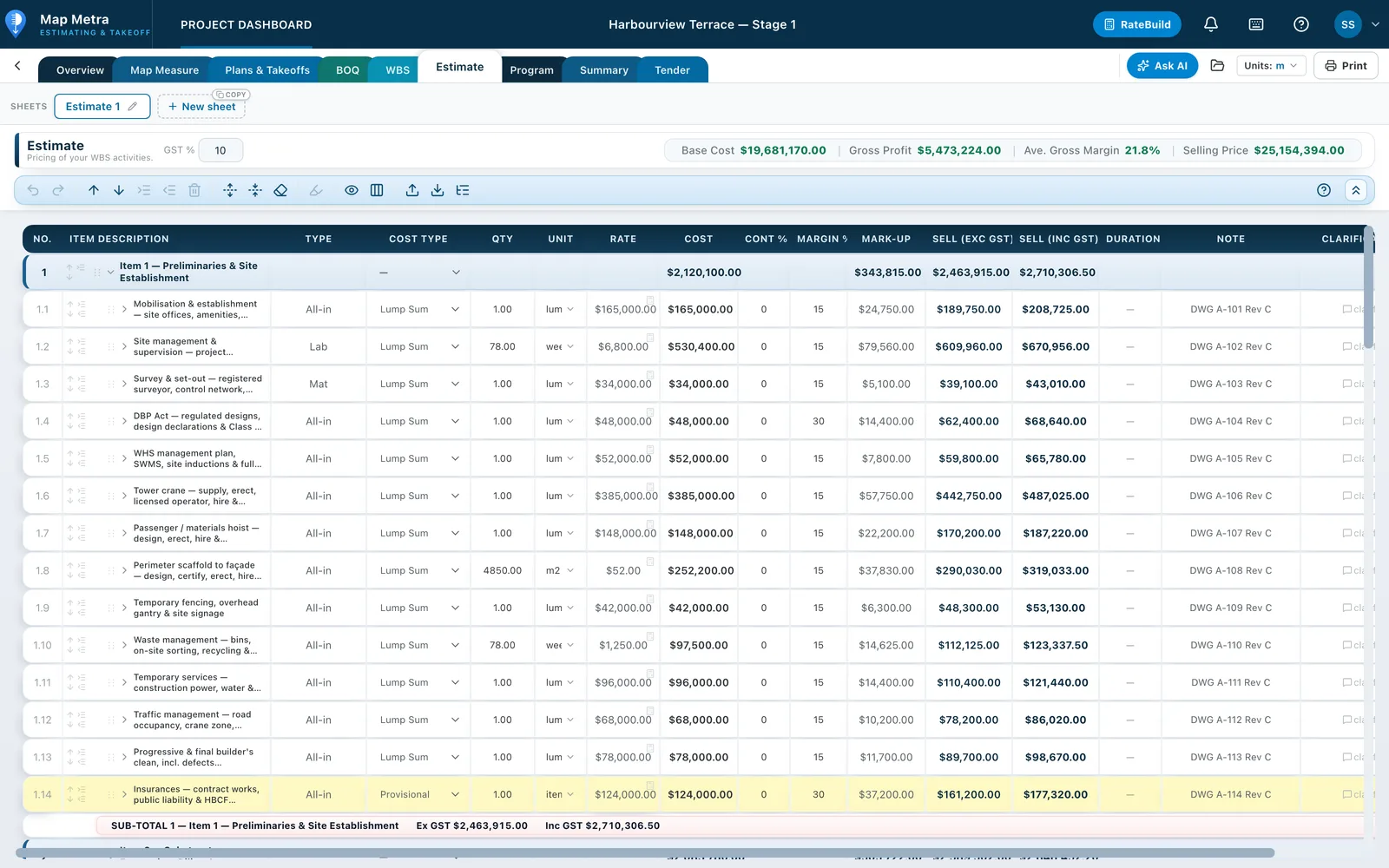
In Map Metra you can price a line from a reusable unit-rate build-up in RateBuild, enter labour, material, equipment and subcontract components directly, or set a labour allowance from workers, working days and a daily rate. Because the construction program is built from the same estimate, time-related costs stay consistent with the durations you plan.
Key takeaways
- Analytical estimating prices finished work per unit; operational estimating prices resources for a duration.
- Neither is more accurate in general — each is accurate for the right kind of work.
- Keep fixed and time-related costs out of unit rates and record the basis of every line.